
Fibrous media for wastewater treatment
A specific fibrous media made of bundled polyamide fibers. Microorganisms attached to it remove organic matter (e.g., BOD) and suspended solids (SS) in wastewater. Demonstration tests under the Ministry of Land, Infrastructure, Transport and Tourism’s National Institute for Land and Infrastructure Management (B-DASH Project) confirmed that ①reducing excess sludge and contributing to the improvement of life cycle cost (LCC), and ②restoring wastewater treatment functions damaged by accidents or natural disasters at an early stage through a fibrous media-based wastewater treatment system with portability and rapid start-up capability. Both ① and ② have been incorporated into official guidelines.
Features
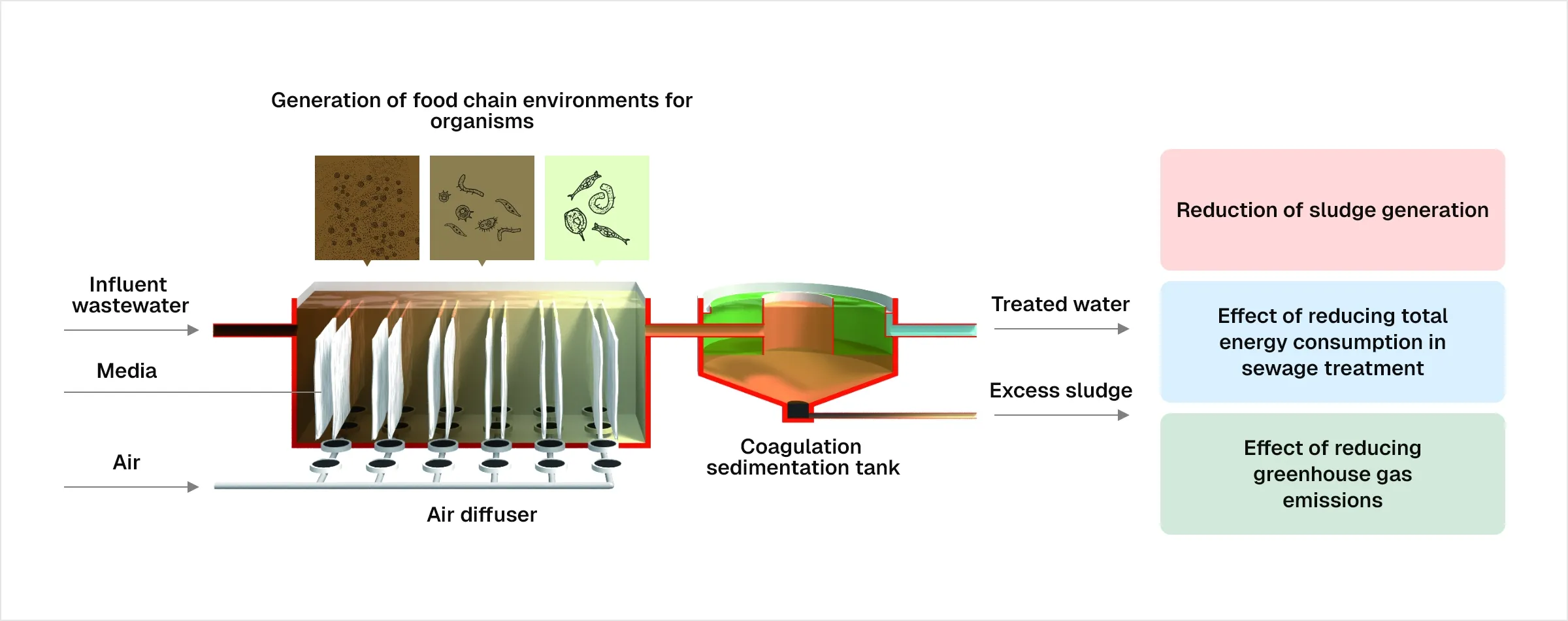
Reduction of excess sludge generation through food chain and self-oxidation (In case of sludge-reduction design)
Capable of treating high-concentration wastewater by retaining a large amount of microorganisms
Applicable to wastewater containing persistent organic pollutants.
※The level of biological treatability varies depending on the subject substance.
Absorbs fluctuations in raw water concentration
Long life due to woven structure
Case Study
1. Design of Excess Sludge Reduction (Sewage, Industrial Wastewater, etc)
The reaction tank is divided into multiple compartments in which these fibrous media are lined up. This setting will create environments where diverse organisms can inhabit, reducing the generation of excess sludge through the food chain and self-oxidation.
| Item | Targets | Demonstration test results |
|---|---|---|
| Basic performance | BOD≦15mg/I Total nitrogen to be reduced by 50% |
BOD≦15mg/I Total nitrogen was reduced by 50% as targeted |
| Sludge reduction | Amount of excess sludge to be reduced by 70% or more | Reduced by 77% |
| Ease of operation | Easy operation management | No need to control the amount of activated sludge. Operation was successful without the need to return sludge. |
※Results of collaborative research with the Japan Sewage Works Agency
2. Design of Sewage Discharge (Industrial Wastewater)
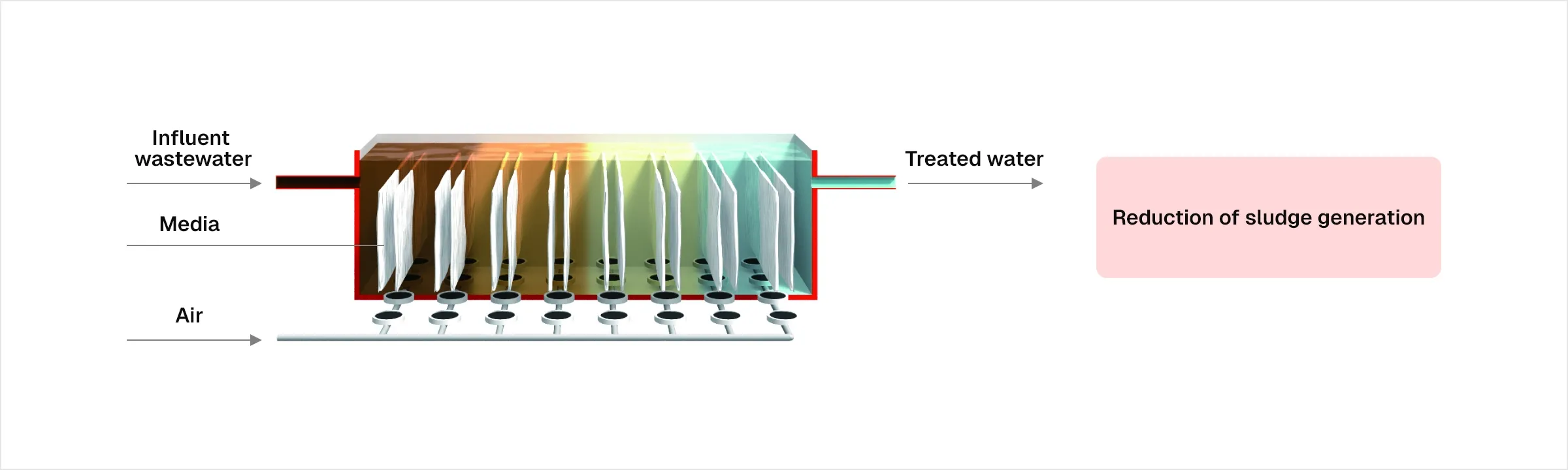
Depending on the wastewater properties and processing conditions, treated wastewater can be discharged directly into a sewer without the need to install a sedimentation tank.
3. Design of High-Load wastewater treatment (Sewage, Industrial Wastewater, etc)
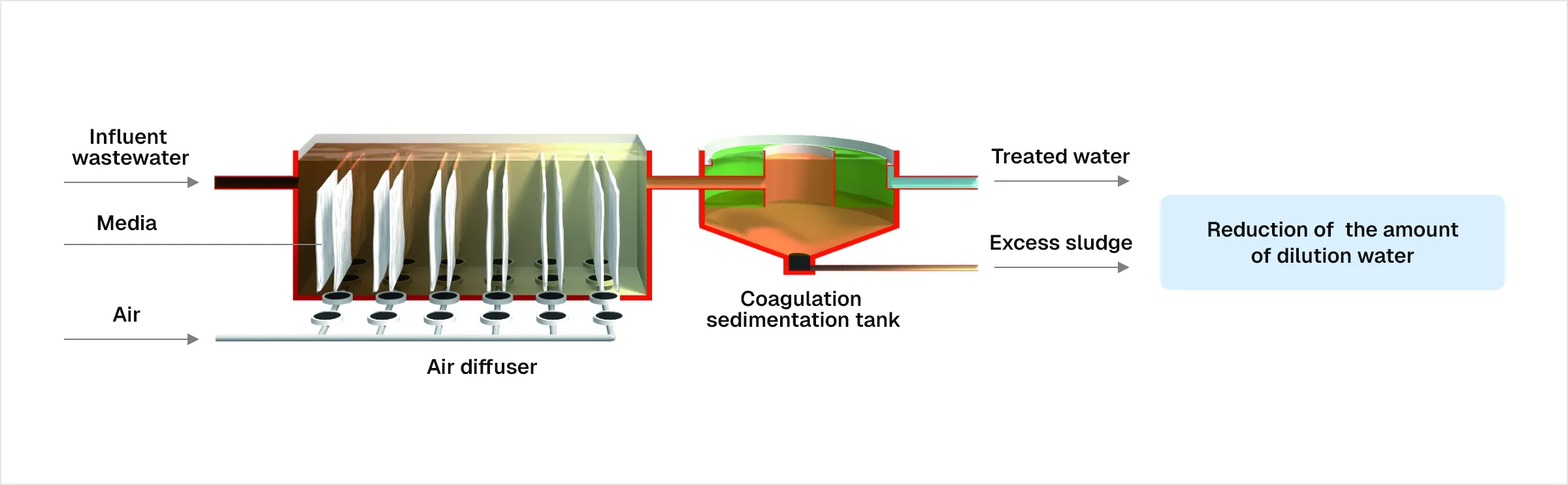
A large number of microorganisms under specific wastewater conditions are retained on the surface of the fibrous media, enabling high-load wastewater treatment while reducing dilution water by combining with a sedimentation tank.
Applications
- Pharmaceutical plant
- Chemical plant
- Automobile plant
- Cosmetics raw material plant
